
Lake Champlain: Doorway to Liberty
Don and Vivian Papson share their knowledge of the Underground Railroad with Gordie Little on Home Town Cable-North Country: Click here to watch!
For fugitive slaves who entered Canada on Northeastern New York’s waterways to freedom, Lake Champlain was a doorway to liberty.
Many of the men, women and children on their way to New York were secreted in Philadelphia, and then forwarded to New York City. From there they were forwarded into New England or through the Hudson River Valley to the Capital Region (Albany and Troy). They were forwarded from the Capital Region through two natural geographical corridors. The first stretched westward across the center of the state to Canada West by way of Syracuse, Rochester, Buffalo and Niagara Falls. (At Syracuse, some fugitives were sent to Oswego.) The other extended northward to Lake Champlain and Canada East.

State of New York with Canals and Rail Roads, 1868
Movement of the self-emancipated to Lake Champlain was facilitated in 1823 with the inauguration of the Champlain Canal which connected the lake to the Hudson River. Freedom seekers were now able to proceed up the Hudson River, into the Champlain Canal and then down Lake Champlain to Canada.
The Lake Champlain corridor was the most direct route to freedom from Albany and Troy.
Champlain Canal, 1895 by Howard Pyle
__________________________________________________________________________________________
Sources:
1868 color map of New York canals and railroads. University of Rochester, Department of History. 2 April 2009. http://www.history.rochester.edu/canal/map/1868ny.jpg
Champlain Canal, 1895 photo by Howard Pyle, courtesy Ray Allard.
__________________________________________________________________________________________
Stories
Stories of fugitive slaves who travelled on Lake Champlain illuminate the lake’s importance to the Underground Railroad.
A Narrative of the Adventures and Escape of Moses Roper, from American Slavery is the earliest known account.
Moses Roper
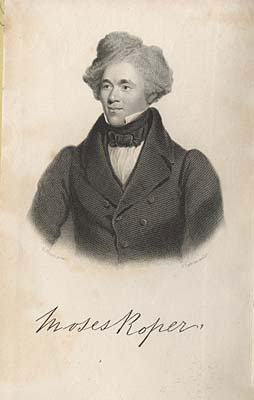
Moses Roper was born in Caswell County, North Carolina, about 1815 on a day and in a month he never knew. He was the son of an enslaved woman named Nancy, who was part African and Indian, but mostly white, and plantation owner Henry Roper. A few months before Moses’ birth, his father married his mother’s young mistress. She was so angry that Moses looked like her husband, that she tried to murder him with a knife. Just as she was about to stab Moses, his grandmother grabbed the weapon and saved his life.
When he was about six or seven years old, Moses and his mother were sold to different masters. He was subsequently resold several times. He ran away repeatedly, but he was always captured and punished. Finally, in 1834, he escaped from Savannah, Georgia, on a ship which was headed for New York.
Roper wrote, :
...When I arrived in the city of New York, I thought I was free; but learned I was not, and could be taken there. I went out into the country several miles, and tried to get employment, but failed, as I had no recommendation. I then returned to New York, but finding the same difficulty there to get work as in the country, I went back to the vessel, which was to sail eighty miles up the Hudson River, to Poughkeepsie. When I arrived, I obtained employment at an inn, and after I had been there about two days, was seized with the cholera, which was at that place....
As soon as he regained his health, Roper took a steamboat to Albany where he hired out as a steward on an Erie canal boat. After going west 350 miles, he felt increasingly unsafe, so he returned to Albany, boarded a Champlain Canal packet boat and headed for Vermont. In the Green Mountain State, Roper worked as a field hand until he saw a newspaper advertisement for his capture. He went east to New Hampshire, where he stayed briefly before moving on. In Boston, he affiliated with abolitionists and signed the constitution of the American Anti-Slavery Society. By late 1835, however, his fear of being captured grew so intense he decided to leave the United States. Retracing his steps back through Vermont, he hid for a short time, and then went to New York City, where he boarded the Napoleon for Great Britain. In Liverpool, Roper presented a letter of introduction to British abolitionists, who warmly welcomed him. He then went to London, where he began to obtain a formal education. Roper published his narrative in the summer of 1837, and he gave hundreds of lectures in English and Scottish churches. In 1839, he married an Englishwoman from Bristol, Ann Stephens Price. In 1844, they sailed for Canada.
Moses and Ann Roper have many descendants living in Australia.
__________________________________________________________________________________________
Sources:
Map of New York, Fannings Illustrated Gazetteer of the United States (New York: Ensign, Bridgman, & Fanning, 1854).
Moses Roper, Narrative of the Adventures and Escape of Moses Roper, from American Slavery. Berwick -upon-Tweed: Published for the author and printed at Warder Office, 1848. Documenting the American South. University Library, The University of North Carolina at Chapel Hill. 3 February, 2009. UNC-Chapel Hill University of North Carolina at Chapel Hill, 2004. http://docsouth.unc.edu/neh/roper/summary.html
__________________________________________________________________________________________
The 1837 Ogdensburg Fugitive
A second early account of a fugitive from slavery who followed Lake Champlain to Canada appeared in anti-slavery newspapers in 1837. He was a man of “middle age, of noble size, six feet high...[who] made his escape from the southern States, and passed up the Champlain canal, and from Clinton county, passed through Franklin county, into the north part of St. Lawrence county, with intent to go to Ogdensburg, and cross over into Canada....” Ogdensburg was the narrowest point on the St. Lawrence River and provided easy access to refugee communities in Canada West. (See St. Lawrence County.)
Samuel R. Ward
S. R. Ward
Samuel Ringgold Ward must have been one of the most imposing men who escaped to Canada on Lake Champlain. Unlike Moses Roper, he was of unmixed African blood. He was also six and a half feet tall.
Ward’s parents escaped to New Jersey from Maryland in 1820 when he was three years old. However, he did not learn he had been born into bondage until he was an adult. Fearing slave catchers, his parents moved to New York City where they raised Samuel as if he had been born free. Samuel attended the African Free School, worked as a clerk for David Ruggles (the founder of the first New York Vigilance Committee), and then became a Congregational minister. This vocation led to pastorships in Poughkeepsie and Cortland, New York, but his heart was in journalism and abolitionism.
Ward’s cousin, the Rev. Henry Highland Garnet, was one the most powerful voices for black liberation in the 19th century. Both men assisted fugitive slaves on the Underground Railroad. As a traveling agent for the American Anti-Slavery Society and its New York chapter, Ward encountered opportunities to aid his oppressed race. Anti-slavery lecture tours in Eastern New York sometimes commenced in Washington County and proceeded into the northernmost counties. On one such tour in 1840, Ward accompanied New York Anti-Slavery Society Corresponding Secretary, Edward C. Pritchett, and Saratoga County abolitionist E.M.K. Glen. The men took a fugitive slave from Washington County “towards the North Star.” (See Washington County.)
Samuel Ward often felt the sting of color prejudice. In 1840, he experienced a striking example of Jim Crow. While passing through the Mohawk Valley toward Binghamton, where he was scheduled to present a lecture, Ward escorted a “white lady fugitive” who was on her way to Canada. Her complexion was so fair, she was accepted by the “other” white ladies in the railroad cars from Albany to Utica and westward, and “no one suspected that she was not as respectable as the best of them!” To his irate Binghamton audience, Ward exclaimed, “I was, of course, obliged to take my seat in the negro car.”
By 1851, Ward and his wife had decided to move to Canada and “purchase a little hut and garden,” and pass the “remainder of their days in peace, in a free British country.”
But fate intervened. On October 1, 1851, William “Jerry” Henry was arrested in Syracuse and charged with being a fugitive slave. The incident occurred just as delegates were gathering for a Liberty Party convention. Ward joined a committee to devise a plan to rescue Jerry from the city jail. He had never seen anyone in chains. He was so moved by Jerry’s pitiful cries, he helped file the manacles off his body and send him to Canada.
Ward was now in danger of being arrested for violating the Fugitive Slave Act. He let his newspaper, The Impartial Citizen, breathe its last breath, and started for Canada. Following the Champlain Line of the UGRR, he took a Lake Champlain steamboat north. En route, he wrote a letter to Henry Bibb, who was publishing an abolitionist newspaper, Voice of the Fugitive, in Toronto. Bibb had escaped from slavery in 1837, but the Fugitive Slave Bill of 1850 had convinced him he had best flee from the United States. Ward informed Bibb,
...I am, like yourself, a refugee... I have come to Canada, and I am now on my way from Montreal to your part of the Province, making, or intending to make, Toronto my headquarters for the winter. I do not, of course, find Canada free from Negrophobia. As an instance of Canadian Negro hate, I took passage today, at Lachine, for Kingston. I could get a cabin passage, on the steamer St Lawrence, which carries Her Majesty's Mail, upon no terms whatever! Mr. Kelly, the Purser, declared that there was no room for me. There were half-a-dozen stateroom keys, uncalled for, in the office at the time! And the cabin saloon was much less crowded than was the deck. I concluded to sail but a short distance upon the infernal craft, but I could not have a cabin passage for over three hours! I therefore staid at this point, running the risk of finding a better chance in some other boat this evening. On Lake Champlain, the Francis Saultus [Saltus] gave me a cabin passage without hesitancy. The same is true on the Hudson River. But the St Lawrence... compels a black man to take a deck passage – or none. The boast of Englishmen, of their freedom from social negrophobia, is about as empty as the Yankee boast of democracy. I believe that a universal agitation, by the press and the tongue, in church and at the polls, will rid our beloved adopted country of this infernal curse. God forgive me when I shall refuse or neglect to do my humble part in this agitation!...
Yours in exile and in hope,
S.R. Ward.
Ward had experienced color prejudice many times in the United States, and the respectful treatment he received on the Francis Saltus made a lasting impression on him.
.
The Francis Saltus
In Montreal, Ward met with several abolitionists and the celebrated refugee, Shadrach Minkins. Shadrach had fled to Montreal from Boston by way of Vermont just eight months earlier. A vigilance committee of black men led by Lewis Hayden had rescued Shadrach from the Boston Court House. (See Canada.) Seven years earlier, Hayden had escaped from Lexington, Kentucky with the help of Rev. Calvin Fairbank and Delia Webster, a school mistress and native of Vergennes, Vermont.
The St. Lawrence
A few months after Ward escaped to the Queen’s Dominions, he greeted his wife and three children in their adopted country. He was outraged when his wife told him the captain of the boat on which they traveled had refused to seat them anywhere “save on the deck.”
Ward became active with the Anti-Slavery Society of Canada. In 1853, the Society sent him to Great Britain. His anti-slavery lectures grew responsive crowds. In 1855, he published his life story, Autobiography of a Fugitive Negro.
From England, Ward emigrated to Jamaica, where he settled on a small piece of land he had been given while in England. He died sometime in the mid-1860s.
Frederick Douglass had high praise for Ward. He wrote, “In depth of thought, fluency of speech, readiness of wit, logical exactness, and general intelligence, Samuel R. Ward has left no successor among the colored men amongst us, and it was a sad day for our cause when he was laid low in the soil of a foreign country.”
__________________________________________________________________________________________
Sources:
ANOTHER ‘WHITE’ LADY FUGITIVE.” The Friend of Man, February 19, 1840.
Frederick Douglass, Life and Times of Frederick Douglass. Boston: De Wolfe & Fiske Co., 1892: 345. Documenting the American South. University Library, The University of North Carolina at Chapel Hill. 3 February, 2009. UNC-Chapel Hill University of North Carolina at Chapel Hill, 2001. http://docsouth.unc.edu/neh/dougl92/dougl92.html
Image of the Francis Saltus, Delaware and Hudson Champlain Transportation Company Steamship Francis Saltus. 31 March 2009. http://www.trainweb.org/dhvm/photographs/steamboats/steamboats_Francis-Saltus.htm. taken from Jim Shaughnessy, Delaware & Hudson: The History of an Important Railroad Whose Antecedent Was a Canal Network to Transport Coal (Berkeley, California: Howell-North, 1967).
Image of the St. Lawrence from W.S. Hunter, Panoramic Guide from Niagara Falls to Quebec (Boston: John P. Jewett & Company, 1857).
Peter Ripley, ed., The Black Abolitionist Papers Vol 11 Canada, 1830-1865 (Chapel Hill and London: The University of North Carolina Press, 1986).
Samuel Ringgold Ward, Autobiography of a Negro His Anti-Slavery Labors in The United States, Canada & England (Chicago: Johnson Publishing Company Inc., 1970) rept. of 1855 edition by John Snow of London.
__________________________________________________________________________________________
Lavinia Bell
After several failed attempts to escape from slavery in Texas, Lavinia Bell followed the North Star to New York in January of 1861. When she arrived at Rouses Point, New York’s northernmost port on Lake Champlain, a kind man performed the “Christian act” of paying her train fare to Montreal.
This is an abridged account of her escape:
Narrative of the Escape of a poor Negro Woman from Slavery
(From the Montreal Gazette)
We lay before our readers to-day a brief account of the sufferings of a poor woman from the lips of the woman herself.
Born in Washington of free parents, while yet an infant stolen, she was taken down to Galveston, Texas, the property of William Whirl. She was brought up as a show girl, taught to dance, sing, cackle like a hen, or crow like rooster, sent into the cotton field with no clothes whatever, exposed to the glare of a southern sun, harnessed to a plough. She often attempted to escape, but, having no knowledge of the way, was easily overtaken. She and her husband made an unsuccessful attempt. The poor man was shockingly beaten and died. Her mistress, Polly Whirl, at last told her of Canada, that refuge for the hunted fugitive, and pointed out to her the North Star as her guide by night. This, of course, was done without the knowledge of the brute Whirl.
She again started, subsisting on herbs and nuts, gave birth to twin children, one of them dead. Her master, having some difficulty proving her identity, slit both her ears, then branded her on the back of her left hand with a hot iron, cut off with an axe the little finger and bone of her right hand, searing the wound with a hot iron, branded her on the stomach with a letter. She again escaped. They took her child from her. Again she got away, traveling through Ohio to New York State. When near Rouses Point, some man performed the Christian act of paying her way to Montreal by railroad, and on Monday evening last she arrived here, was brought to the house of a man of her own race, Mr. Cook, in a state of perfect destitution. Her object now is to earn money to support herself, and raise enough to purchase the freedom of her child. The poor woman is still very ill, but is receiving every medical attendance from Dr. Reddy, who will continue his attendance as long as necessary.

Rouses Point Steamboat and Train Terminal
On January 28, Dr. Reddy reported,
I was requested by Mr. Cook to call and see a Negro woman who had arrived the previous day in Montreal, he telling me she was very ill from injuries she had received while a slave. On visiting the woman, she complained of severe pain in her right side, cause as she said, by a violent wrench which she had received at the hands of her owners. On making examination I found her body very much distorted, her spine curbed towards the right side and the ribs forced completely in the same direction, having a very bulged appearance. I also found the following marks of ill treatment on her person. A 'V-shaped' piece had been slit out of each ear; there was a depression on the right parietal bone where it had been fractured and is now very tender to the touch; the corresponding spot on the opposite side had a large scar uncovered by hair; there is large deep scar, 3 1/2 inches long on the left side of the lower jaw; several of her teeth are broken out; the back of her left hand has been branded with a heated flat-iron; the little finger of her right hand, with a portion of the bone that it connected with, has been cut off; the abdomen bears the mark of a large letter 4 inches long in one way and 2 1/2 inches in another, also branded with a hot-iron; her ankles are scarred, and the soles of her feet are all covered with little round marks apparently inflicted with some sharp instruments which she accounts for by her stating that she was obliged to walk over hackles used for hackling flax; her back and person are literally covered all over with scars and marks now healed, evidently produced by the lash. Altogether she presents a most pitiable appearance.
Bud Jones of Brockville, Ontario, has a proud addendum to the story:
The person who aided her in her flight was young George Edward Jones, My Great-Grandfather's younger brother whose off-spring still reside in Montreal. And who had made many journeys back to the States as a conductor on the UGR. My Great-Grandfather James Henry Jones, also a Barber, (all the Jones's were Barbers and at one time all worked together in McGill Street.) As a matter of fact, after George died Anna Cook known in the Black Community a "Granny Cook" took in George's daughter Isabella after his death and adopted her. She later became "Granny" Johnston to the community, and had inherited all of the Cook property which included a large Country home in Plage Laval, just on the outskirts of Montreal.
UGRR Conductor George Edward Jones
of Montreal, Canada.
On April, 12 1861, a lease for a one-story wooden dwelling at 4 St. Urbain Street was signed by a laborer named William Henry Smith and “Levinia Wormeny widow of late Henry Bell in his lifetime, of Texas.” Each made the mark of an X, a sign used by people who had not had the privilege of learning how to write their name.
Two weeks later, someone else signed a lease for the same dwelling.
We are left with an unanswered question: what became of Mrs. Bell?
In 2007, retired educator Ella Lewis portrayed Lavinia Bell during the Galveston Historical Society’s Juneteenth celebration. Juneteenth is a widely observed annual celebration which commemorates June 19, 1865, as the day when General Gordon Granger and 2,000 federal troops arrived in Galveston, Texas, to enforce the emancipation of slaves in the Lone Star state. The United States had abolished slavery two and one half years earlier.
The dramatic life of Lavinia Bell is featured in our DVD, Northward to Freedom. For broadcast rights, contact the Agency for Instructional Technology.
For an article on Rouses Point, see our Winter-Spring 2007-2008 newsletter.
__________________________________________________________________________________________
Sources:
Montreal Witness February 2, 1861, courtesy John Leblanc.
Bud Jones, e-mail to author (n.d.).
Frank Mackey, Black Then: Blacks and Montreal 1780s-1880s. (Montreal & Kingston, London, Ithaca: McGill-Gueen’s University Press, 2004).
Galveston Historical Foundation Presents “The Making of the Underground Railroad: From Slavery to Freedom” Galveston Historical Foundation, 11 June 2007, press release, 3 March 2009.
http://www.galvestonhistory.org/Underground_Railroad.asp
Image of George Edward Jones, courtesy Bud Jones.
John W. Blassingame, ed. Slave Testimony: Two Centuries of Letters, Speeches, Interviews, and Autobiographies, ed. (Baton Rouge: Louisiana State University Press, 1977).
Lease of 12 April 1861 from Louis Dechantal to William Henry Smith et al. Deed #6586 from the records of notary Joseph-Evariste-Odilon Labadie at Archives nationales du Québec.
“Narrative of the Escape of a Poor Negro Woman From Slavery” was published in three Montreal newspapers. It first appeared in the Montreal Gazette and Evening Pilot on January 31, 1861. An abbreviated version was published in the Montreal Witness on February 2, 1861.
Rouses Point Steamboat and Train Terminal image, courtesy Special Collections, Benjamin F. Feinberg Library, State University of New York at Plattsburgh.
__________________________________________________________________________________________
UGRR Agents and Conductors
In New York City, Reverend Charles B. Ray was one of the most important agents.
Rev. Charles Bennett Ray
This is Ray’s description of how the UGRR operated to and from New York City:
This road had its regular lines all the way from Washington; between Washington and Baltimore, a kind of branch. It had its depots in Philadelphia, New York, Albany, Troy, Utica, Syracuse, Oswego and Niagara Falls. New York was a kind of receiving depot, whence we forwarded to Albany, Troy, sometimes to New Bedford and Boston, and occasionally we dropped a few on Long Island, when we considered it safe so to do. When we had parties to forward from here, we would alternate in sending between Albany and Troy and when we had a large party we would divide between the two cities. We had here, on one occasion, a party of twenty-eight persons of all ages, from the old grandmother to a child of five years old. We destined them to Canada. I secured a passage for them in a barge, and Mr. Wright and myself spent the day in providing food, and personally saw them on the barge. I then took the regular passenger boat foot of Cortlandt Street and started. Arriving in the morning I reported to the Committee at Albany, and then returned to Troy and gave Brother Garnet notice, and he and I spent the day in visiting friends of the cause there, to raise money to help the party through to Toronto, Canada via Oswego. We succeeded, with what they raised in Albany, in making up the deficiency in my hands, to send them all the way from here to safety.
“Mr. Wright” was probably Rev. Theodore Wright, pastor of New York City’s Shiloh Presbyterian Church. “Brother Garnet” was the Rev. Henry Highland Garnet, pastor of Troy’s Liberty Street Church.
Rev. Henry Highland Garnet
At a National Colored Convention in Buffalo in September of 1843, Rev. Garnet called upon slaves to rebel against their masters: “Brethren arise, arise! Strike for your lives and liberties. Now is the day and the hour. Let every slave throughout the land do this, and the days of slavery are numbered.... Rather die freemen than live to be slaves. Remember that you are four millions!”
Frederick Douglass stood up and said Garnet’s address displayed “too much physical force.” If adopted, his sentiments would spark a mass rebellion which would accomplish nothing. By one vote, the delegates rejected Garnet’s call for insurrection.
One month after the Buffalo convention, pro-slavery men broke into the Liberty Street Church, ran off a group of fugitives Garnet was hiding, wrestled him to the floor, and took turns spitting on him. A recent amputee with only one leg, he crawled home, more determined than ever to fight for the freedom of his people.
Charles Bennett Ray was not the only agent in New York City who forwarded people to the Capital Region. In the 1850s, Sydney Howard Gay sent many fugitives to Albany. A member of the Executive Committee of the American Anti-Slavery Society, Gay edited the Society’s newspaper, the National Anti-Slavery Standard.
S.H. Gay sent fugitive slaves to Stephen Myers and to Jermain Loguen in Syracuse. He worked closely with another black man, Louis Napoleon. Gay and Napoleon received many people from William Still of Philadelphia. Napoleon conducted some of them to Albany.
William Still
A good number of the people Still sent to New York had been sent to him by Thomas Garrett of Wilmington, Delaware.
Thomas Garrett
During his UGRR career, the great Quaker abolitionist Thomas Garrett helped nearly 3,000 people. He provided assistance to the most famous of all Underground Railroad conductors--Harriet Tubman. He gave her money to buy shoes for fugitives and hire teamsters to transport them in wagons.
Harriet Tubman
Harriet Tubman was in Troy, New York, when U.S. Marshals arrested Virginia fugitive slave Charles Nall in 1858. She played a central role in Nall’s rescue.
The ever-growing number of fugitive slaves forwarded to New York by William Still and other members of the Philadelphia Vigilance Committee made New York City a great “receiving depot.” The next stops were Troy and Albany.
Albany
Albany was the major receiving and forwarding depot for fugitive slaves sent north from New York City on the Hudson River and through the Hudson River Valley. By 1849, the Vigilance Committee in New York City had aided 2,000 people.
Although some of the runaways who arrived in New York City were sent to New England, most were forwarded to Albany, where Stephen Myers was the Superintendent of the UGRR for many years.
Stephen Myers
Stephen Myers, his wife, Harriet, and other members of the Albany Vigilance Committee received hundreds of people. The following 1842 newspaper account reveals the scope of their work:
Runaway Slaves.--The report of the Vigilance Committee of the Abolitionists at Albany, for the last year states, that they have added about 350 runaway negroes since the opening of navigation last Spring. Of these fugitives, about 150 were men, 150 women, and 50 children. Most of them came from Virginia, Maryland and the District of Columbia, and nearly or quite a hundred from Washington and Georgetown. These fugitives have gone chiefly to Canada, and the sum of $500 has been expended for their board, passage, and other expenses.
Stephen Myers forwarded most of the freedom seekers he sheltered to Syracuse or Oswego, but sometimes he sent people directly north. In 1842 he reported, “We assisted two slaves that were sent to our office by William Garner of Elizabethtown [N.J.]; we furnished them with money for Canada by way of Lake Champlain.”
Myers may have assisted runaways while working as a steward on the steamboat Armenia, which operated between New York City and Albany.
Replica of Hudson River steamboat Armenia which began service on the Hudson River in 1848
In August of 1860, Harriet Myers wrote a letter to the abolitionist lawyer William Jay to inform him that two fugitives he had forwarded to her husband from Westchester had arrived with the money he had given them, and it was enough to get them to Canada. Eight others had arrived that month without any money. Harriet had to take care of them because her husband was in Lake George working as a butler.
In December, Mr. Meyers reported to William Jay that he had received more fugitives in the preceding eight weeks than he had in any previous four-month period.
The impressive UGRR history of Albany is celebrated today by the Underground Railroad History Project of the the Capital Region, Inc. This outstanding group organizes an annual UGRR conference, conducts walking tours, and is in the process of restoring the former home of Stephen and Harriet Myers. (See http://www.ugrworkshop.com)
__________________________________________________________________________________________
Sources
Armenia Broadside. “An American Time Capsule, Three Centuries of Broadsides and Other Printed Ephemera,” Rare Books and Special Collections Divisions of the Library of Congress.
Earl Ofari, Let Your Motto Be Resistance ( Boston: Beacon Press, 1972).
Harriet Myers, letter to William Jay, Aug. 20, 1860. John Jay Homestead State Historic Site, Katonah, New York.
Martin Burt Pasternak, Rise Now and Fly to Arms: the Life of Henry Highland Garnet. University of Massachusetts Ph D. 1981. University Microfilms International.
“Runaway Slaves.” The Constitution, Jan. 11, 1843.
“Special Call.” Emancipator and Free American, May 4, 1843.
Photo of Replica of Hudson River steamboat Armenia, courtesy Tom Calarco.
Stephen Myers, letter to William Jay II, Dec. 17, 1869. John Jay Homestead State Historic Site, Katonah, New York.
“To the Public.” Northern Star and Freemen’s Advocate, Dec. 8, 1842.
__________________________________________________________________________________________
The Reverend Abel Brown
Abel Brown challenges slavery
In the 1840s, there was another very important UGRR agent in Albany. His name was Abel Brown. An ordained minister, Brown was the Corresponding Secretary of the Eastern New York Anti-Slavery Society. In May of 1843, the society’s Executive Committee announced that over five hundred fugitive slaves had been aided during the previous year. Jeremiah Boggs from Virginia was sent to St. Albans, Vermont. He was doing well, working for an abolitionist and learning how to read. Then he was recognized by someone who knew his master. Boggs decided to go to Liberia, a colony in West Africa which had been established by the American Colonization Society. (See Western Vermont.)
In the fall of 1843, Rev. Brown reported:
“FUGITIVES. ‘The cry is still they come.’--Two, yesterday morning, and two this morning...Will our friends send in funds to the Treasurer of the Eastern New York Anti-Slavery Society, to defray the expense of forwarding them on? Money! money! friends. The two fugitives last mentioned, we are informed, were followed to New York by their master--both master and slaves arriving at the same time--he on one boat and they on another. Happily, some colored hands on one of our North River towboats secreted them on board, and they arrived in this city in safety this morning.”
The abolitionist journalist Charles Torrey went to Washington D.C. to operate an UGRR route to the Capital Region. Torrey worked with Thomas Smallwood, a free black man. But helping fugitive slaves was a dangerous business, and Smallwood had to flee to Canada.
UGRR Conductor Charles Turner Torrey.
In 1842, Torrey drove fifteen men, women and children in a wagon to Troy and put them on a canal boat for Canada. Torrey helped one man who chose not go to Canada. The man was a fugitive from Maryland, and his name was Lewis Washington.

Lewis Washington
Abel Brown hid Lewis until all danger of his being captured had passed. Then Lewis joined Abel on his anti-slavery lecture tours. Audiences were moved by Lewis’ stories of the four decades he had spent in slavery.
When the two men visited Massachusetts in the winter of 1842, Abel, a widower, took special notice of Catherine Swan, a young female abolitionist.

Catherine Swan Brown Spear
It was not long before Abel and Catharine were married by New York City UGRR stationmaster Rev. Charles B. Ray. Catherine joined her husband on the lecture circuit and sang anti-slavery songs. They traveled 3,000 miles in 18 months.
Abel Brown’s influence reached beyond Albany. In October of 1843, he visited Clinton County. He lectured twice in Chazy, and was taken by Noadiah Moore to his “hospitable mansion” in Champlain. Moore’s home was the last safe house on a route which began in Albany and passed through Troy, Glens Falls, Keeseville and Peru. (See Clinton County) After giving two lectures in Champlain and one in Moresville (Mooers), Brown took a steamboat from Plattsburgh for St. Albans, Vermont, where he lectured twice. He then took a steamboat to Whitehall and boarded a canal packet boat for Albany.
On January 31, 1844, an announcement appeared in the Essex County Times. Abel Brown would be in Elizabethtown for a two-day county convention beginning February 13th. Lewis Washington would also address the convention. The announcement continued, “The committee expect a hearty response from those who will not barter in the price of blood. Our enemies are strong--our cause is just. Freemen! to the rescue!!”
In July, Brown returned to the Adirondacks and wrote this gleeful message to his wife:
We took the Steamboat Burlington, commanded by Capt. Sherman, --and, permit me to say, that if you wish to see the most perfect specimen of a steamboat and a steamboats commander, be sure to take passage on the Burlington.... Many a slave has enjoyed the indescribable pleasure of leaping from the liberty-loving “Burlington,” to feel the pleasure of being free under the protection of a Queen whose pleasure it is to make the lowest of her subjects happy.

Captain Richard Sherman
A broadside for the Burlington
Richard W. Sherman, familiarly known as “Captain Dick Sherman,” gained the reputation of being the “ideal” steamboat captain. Although he commanded a number of steamers during his career, he secured his reputation with the Burlington, which had the distinction of being the finest and most efficiently commanded steamer on Lake Champlain. Sherman “conducted his boat very much as a gentleman would conduct his private yacht or establishment, seating his passengers at the table and seeing to their wants.”
On August 13, 1844, an announcement appeared in the Plattsburgh Republican for a second Abel Brown tour. This one would be grueling--10 lectures in 12 days. It was hoped that Mrs. Brown would be able to attend and share her “unaffected vocal powers. If not, the native eloquence of Louis Washington” would “go far to compensate for the want of music. A colored man would accompany Mr. Brown in any event.” The first stop would be at the Quaker Union, where Samuel Keese was the head of the UGRR depot. Their tour would also include a stop in the village of Champlain, where Noadiah Moore sheltered fugitive slaves rushed to him in a wagon pulled by Samuel Keese’s fastest horses. Moore took the freedom-seekers across the border to Lacolle, where he owned mills and was able to help them find work. It is likely that some of the freedom-seekers Keese and Moore assisted were forwarded to them from Albany by Abel Brown.
The winter of 1844 was setting in when Brown traveled to western N.Y. for an anti-slavery convention. A terrible snow storm came up, and he stopped at a house to ask if he could stay the night and complete his journey in the morning. The request fell on unsympathetic ears. Brown was forced to continue on to Canandaigua. He was exhausted when he arrived, and a tormenting fever soon took his life. The “Colored citizens” of Canandaigua expressed their “deep and pungent grief.”
Abel Brown was only 34 years old when he died. His befreft widow, Catherine, was expecting a baby. She lovingly compiled and published his memoirs with the hope that they would provide a source of income for herself and her unborn child. Catherine would give birth to a son and name him Abel.
Catharine Swan Brown recounted an “extremely interesting” case of a fugitive named William who was forwarded to Albany from New York City by Charles B. Ray in “care of Mr. Abel Brown.” William arrived one morning during her husband’s absence, and during the three days she cared for him, “he was constantly in dread of being taken by his pursuers!” She grew protective of William and wanted him to stay in Albany, but Mr. Brown had found a place for him near Lake Champlain, where he was “immediately conveyed.”
After Abel’s death, Catharine dedicated herself to a different cause. She married the “Prisoner’s Friend,” Charles Spear. She made his mission her own, but she never forgot the day she met Abel Brown. That was the day she was told Brown was a second Moses who had helped “a thousand slaves” to freedom.
Two years after Abel Brown died in western New York, Charles Torrey died in a Maryland penitentiary. Sentenced to a six-year prison term for aiding fugitive slaves with no hope of a pardon, Torrey succumbed to pulmonary tuberculosis at the age of 33. In his brief life, he had helped 400 fugitives escape from slavery.
Lewis Washington moved to Peterboro, New York, where he accepted a parcel of land from the wealthy abolitionist, Gerrit Smith. He then moved his family to Wisconsin where he lectured on behalf of the Liberty Party before settling on a farm. Finally, he moved to Omaha, Nebraska.
__________________________________________________________________________________________
Sources:
Burlington and Washington Steamboat Broadside. Ralph Nading Hill, Lake Champlain: Key to Liberty (Woodstock, Vermont: The Countryman Press, 2004).
Catherine S. Brown, Abel Brown, Abolitionist. ed. by Tom Calarco ( Jefferson: McFarland & Company, Inc., 2004).
C.S. Brown, Memoir of Rev. Abel Brown (Worchester: Published by the Author, 1849)
Essex County Times, Jan. 31, 1844.
Florence T. Ray, Sketch of the Life of Rev. Charles B. Ray. (New York: Press of J.J. Little & Co, 1887).
“Fugitives.” Emancipator, Sept. 29, 1843.
Image of Lewis Washington. Google Book Search,Chauncey C. Olin, “Lewis Washington” pp. XLII-LII in: “Reminiscences of the Busy Life of Chauncey C. Olin” in: A Complete Record of the John Olin Family ... (Indianapolis: Baker-Randolph Co., 1893), 3 March 2009 http://www.wisconsinhistory.org/turningpoints/search.asp?id=1557
Sketches of the Burlington and Captain Sherman. Annual for the Year 1892 The Essex County Republican, With sketches and portraits of noted men and women of the Champlain Valley and Adirondacks. Second Series. With Compliments of W. Lansing & Son.
__________________________________________________________________________________________
Troy
Rev. Fayette Shipherd, minister of the
Free Congregational Church of Troy.
In a series of responses to UGRR historian Wilbur Siebert, the old abolitionist lawyer Martin Ingram Townsend of Troy, New York, shared his recollections of the UGRR:
...the colored man was always a welcome guest at the house of a colored man who bore the name of John N. Hooper--Hooper was a man who owned his house and lived by Whitewashing. He was a Marylander & Lived near Fred Douglass in his Boyhood. When a fugitive arrived at Troy, a fund was raised to send him or her to Suspension Bridge or Rouses Point--White People made individual contributions...
Townsend provided further clarification,
...fugitives from slavery always traveled from Troy to the Canada line with perfect Safety--whether by Vermont & Lake Champlain--and by Suspension Bridge. When they reached Troy they only needed money to pay their fare for the rest of their voyage...
In November of 1840, Rev. Fayette Shipherd sent a letter to Garret Van Hoosen of Hoosick, Renesalaer County. The letter was addressed to Charles Hicks of Bennington, Vermont. Shipherd informed Hicks,
As the canal has closed I shall send my Southern friends along your road & patronize your house. We had a fine run of business during the season...We had 22 in two weeks 13 in the city at one time. Some of them noble looking fellows I assure you. One female so near white & so beautiful that her master had been offered at different times $1,200-1,500 & 2,000 for foulest purposes. A Baltimore officer--a man hunter was seen in our city making his observations but left without giving us any trouble. Several slaves were in our city from Baltimore at the time. Our Laws are now a terror to evil doers who live by robbery....
__________________________________________________________________________________________
Sources
Fayette Shipherd, letter to Charles Hicks, Nov. 24, 1840. Vermont Historical Society.
Martin I. Townsend, letter to Wilbur Siebert. Sept. 4, 1896. Wilbur H. Siebert Collection (1840-1954), [microform]. ([Columbus]: Ohio Historical Society), reel 8.
__________________________________________________________________________________________
New York City
Isaac Hopper, a Quaker who had begun his Underground Railroad work in Philadelphia and moved to New York City, forwarded fugitive slaves “chiefly by water to Providence & Boston, or by river & canal & Lake Champlain.”

Isaac Hopper
These documented accounts of Lake Champlain and the Underground Railroad highlight an unheralded history. They inform us that Lake Champlain was an Underground Railroad highway, the ultimate link in an extensive and major UGRR network which started in the Southern United States and ended in Canada.
Back to People and Places
__________________________________________________________________________________________
Source
James S. Rogers, letter to Wilbur H. Siebert, April 17, 1897. [the Underground Railroad in Vermont, vol. 1, MIC 192 Wilbur HJ. Siebert Collection (1840-1954) Microfilm Edition] (Columbus: Ohio Historical Society), reel 15.
|